
CROWN AND BRIDGE :-
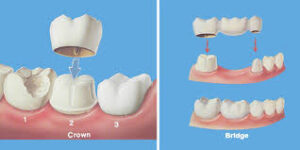
Crown and bridge are fixed prosthetic solutions used to restore damaged teeth or replace missing ones …
CROWN :- It is a cap for a single broken / weakened tooth …
BRIDGE :- It consists of false teeth anchored by crown of adjacent teeth.
Materials includes ceramic, porceline, zirconia with procedures taking 2 or 3 visits to restore functionality and aesthetic.
PURPOSE :-
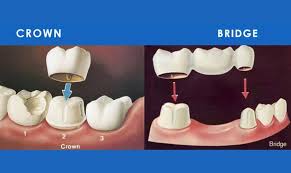
Crown restores strength, shape and appearance to damage, decayed and root filled teeth.
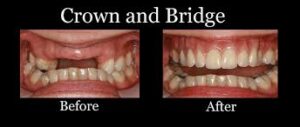
Bridges close gap caused by missing teeth and prevent surrounding teeth from shifting …
TYPES OF BRIDGES :-
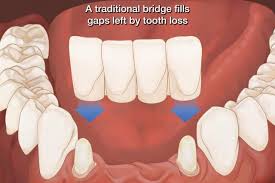
Traditional :- It is supported by adjecent crown.
Cantilever :- It is supported on one side by adjacent crown.
Implant-supported-bridge :- It is supported by artifically placed implant on the gum.
PROCEDURE :-
It involves the following steps,
Tooth preparation for accepting the prosthesis.
Taking impression of both upper and lower jaw.
Placing temporary restoration.
Tryal.
Cementing the custom made permanent crown or bridge.
LIFE-SPAN :-
With good oral hygne ( brushing/flossing), bridge and crown typically lasts 10-15yrs or longer …
MATERIALS :-
Options include metal (gold/alloy), porceline-fused-to-metal (PFM), all ceramic or zirconium for maximum asthetic appeal.
The procedure is generally not painful du local anesthesia.
Maintenance :-
Daily brushing, flossing and avoiding or being careful with very hard /sticky food is necessary to ensure longevity.
DIFFERENCE BETWEEN PORCELINE-FUSED-TO-METAL CROWN AND ZIRCONIUM CROWN :-
PORCELINE-FUSED-TO-METAL (PFM) CROWN :-
PFM crowns are a classic budget friendly option with good strength but risk of visible gray lines at the gums and porceline chipping.
Composition :- Metal alloy base with porceline layered on top.
PROS :- More affordable, good strength for back teeth and reliable.
CONS :- Metal edge can show as a dark line at the gum, porceline can chip or fracture, can cause allergic reaction in some.
ZIRCONIA CROWNES :-
It offers superior natural aesthetics, strength, biocompatibility and durability as a metal free, single block ceramic, but at a higher cost making it ideal for front teeth and long lasting restoretion.
Compositions :- A single, solid block of zirconium oxide ceramic (metal-free).
PROS :- Exceptional strength and durability, biocompatibility, often requires less enamel removal during tooth preparation, better aesthetics, recent advanced technology ensures a highly accurate fit and stain resistant.
CONS :- Higher cost, wear on opposing teeth and can be hard to modify once cemented.
CROWN REDUCTION :-
Crown reduction also called tooth preparation is the essential process of shaving down the natural tooth’s enamel to creat space for a dental crown.
KEY ASPECT OF TOOTH PREPARATION :-
Purpose :- To make room for the crown material, ensuring it is strong and properly contourd.
Dimensions :-
Incisal/Occlusal :- 1.5 – 2.0 mm approximate clearance for strength.
Axial (Sides ) :- 1.0 – 1.5 mm to create proper tapered walls.
Margins :- A chamfer or shoulder finish line of 0.5 – 1.0 mm is typically created.
STEPS :-
Depth Grooves :- Using burs to make necessary, consistant reduction depth.
Reduction :- Removing tooth material between grooves.
Refining :- Smoothing margins and removing sharp corners for optimal fit.
For this purpose verious burs are used.
It is important that for anterior teeth 1.5 mm is ideal for labial surface and for posterior molars often require 2 mm of occlusal reduction is required.
Overall-reduction must be avoided as it weakens the tooth and reduces structural integrity.
ANTE’S LAW :-
It says that the combined root surface area off all abutment teeth ( the teeth from which we are taking the support to replace the missing teeth ) must be greater than or equal to the root surface area of the teeth being replaced.
APPLICATION OF THE LAW :-
If the tooth to be replaced has a larger surface area than the available supporting teeth, then additional supporting teeth maybe required to comply.
ZIRCONIUM CROWN :-
It is a high strength, tooth coloured, metal free dental restoratoin made from zirconium dioxide, ideal for molars du to their durability. They offer excellent aesthetics, biocompatibility and longevity, with less tooth prepparation required compared to other material.
KEY ASPECT :-
Material :- Zirconium dioxide is a biocompatable, durable, white crystalline oxide.
Types :- Monolithic zirconia is known to extreme strength, where as layered zirconia offers better aesthetics often used in PFZ ( Porcelain-fused-to-zirconia ).
Advantage :- High fracture resistance, reduce tooth preparation and hypoallergenic properties.
Disadvantage :- Can some times be too opaque and may causes wear on opposing natural teeth if not polished properly.
Process :- Often fabricated using recent advanced cad/cam technology for a precise, custom fit.
These crowns are ideal for patients seeking a durable, aesthetically pleasing and metal free option, particularly for back teeth …